

Picture a CFO three months from an ERP contract renewal, sitting through the third vendor demonstration of the week. The sales engineer shows an AI agent reading an incoming invoice, matching it to a purchase order, resolving a price discrepancy, and queuing the payment — a controller's whole morning compressed into an approval click. Genuinely impressive, genuinely real. Two weeks later, during contract negotiation, the CFO learns that the agent in the demo runs on a product tier the company's budget does not reach. The proposal on the table is for a smaller edition, sold by the same vendor, under the same brand, with almost none of the capability just demonstrated. Nobody volunteered that distinction. Why would they?
That scenario is not hypothetical, and it is not rare — it is, on the evidence in this piece, a common way an SMB ERP decision gets made on incomplete information in 2026.
What are you actually buying when you sign an ERP contract in 2026? That is the question this piece is built to answer for a company of roughly 50 to 500 employees, or up to about €300m in revenue, weighing an ERP replacement it expects to live with for the better part of a decade. AI maturity, this research finds, now varies more within a single vendor's product line than it does between some competing vendors — which means the comparison most buyers actually make, vendor against vendor, is often the wrong one. The comparison that matters is SKU against SKU.
The answer, in short
Five platforms deserve serious diligence: Oracle NetSuite, Microsoft Dynamics 365 Business Central, SAP — specifically Business One or GROW with SAP, which are not the same answer — Sage — specifically Intacct or X3, also not the same answer — and Acumatica. None of them is uniformly ready for the next decade. Several have shipped genuinely agentic finance capability — software that interprets a task, acts across multiple steps, and asks a person only where it must — but that maturity is uneven by vendor, by product edition, by country, and by which specific finance process you ask about. A feature list will not surface any of those distinctions. This piece is built to.
- A vendor name is not a product. SAP Business One has no confirmed agentic finance capability;
GROW with SAP shipped a live cash-management agent, while a second SAP agent announced alongside it — for posting accrual entries — remains in restricted rollout, GA targeted for Q1 2027. Sage Intacct and Sage X3 diverge almost as sharply. Business Central is not Dynamics 365 Finance, the larger Microsoft SKU our enterprise research graded — the two do not share an AI architecture, and confusing them is an easy, common vendor-briefing error.
- Country, language and SKU are three separate constraints, not one "geography" problem. A
feature can be technically available in a market, unusable in the language a finance team actually works in, and absent from the specific edition on the table — all at once — and a vendor briefing will rarely volunteer which applies.
- The decision is no longer only about accounting functionality. The architectural question
that matters most for a decade-long bet is not which AI features a platform ships this year, but whether an external agent, possibly one this vendor never builds, can reach its data under permissions and an audit trail you control.
This is the SMB companion to our earlier research, Should CFOs Modernise... or Wait for AI-Native ERP?, which graded six enterprise-leaning platforms — including, at their larger SKUs, three vendors that reappear here — and concluded there is no AI-native ERP worth waiting for. That holds here too, for a reason this piece adds: at the SMB tier, the gap is not only between announced and shipped capability. It is between the SKU a company can afford and the SKU the AI marketing describes.
Why this decision has changed
ERP replacements are expensive and infrequent — most finance leaders sign one such contract per decade, if that. Historically that made the selection question narrow: does the platform do the accounting correctly, at the right cost, with acceptable implementation risk? Those questions still matter, but a platform chosen purely on today's ledger functionality now risks a specific, avoidable failure: handling double-entry bookkeeping perfectly while unable to absorb the automation and agentic capability that will define finance execution for the rest of the decade it serves.
The shift is worth stating in three stages, because each changes what a CFO should actually be buying. Yesterday, the ERP was primarily the system of record — it captured what had already happened. Today, it increasingly automates the workflows around that record — matching, routing, flagging. What is now beginning, unevenly and by vendor, is the third stage: AI agents that execute work against ERP data directly, with a person reviewing the exception rather than performing the task. A platform bought on stage-one criteria is not automatically ready for stage three — which makes the more useful question not what reports can this system produce, but what finance work can it actually execute without a person in the loop, and how much of that is shipped today rather than promised for later. A new ERP does not, by itself, fix a process that was never standardised in the first place — automation and AI compound a well-run process and expose a badly-run one faster than either did before, and replacing the ledger will not repair that on its own.
Not every company that suspects its ERP is holding it back needs to replace it — our build, buy, extend or wait framework applies here too, and extending the current platform may be more disciplined than replacing it if the constraint is a single process. What follows assumes replacement is the right call.
What makes an ERP "future-ready" at this scale
Ten dimensions decide whether a platform is a credible 5–10 year bet rather than a snapshot of one release cycle: core finance depth, workflow automation, embedded AI, AI agents, data architecture and AI accessibility, planning and analytics, multi-entity and international compliance, ecosystem and extensibility, implementation practicality, and vendor innovation trajectory. The full framework, with the reasoning behind each dimension, sits alongside the Finance AI Readiness Framework this piece draws on. Two distinctions matter more than the rest.
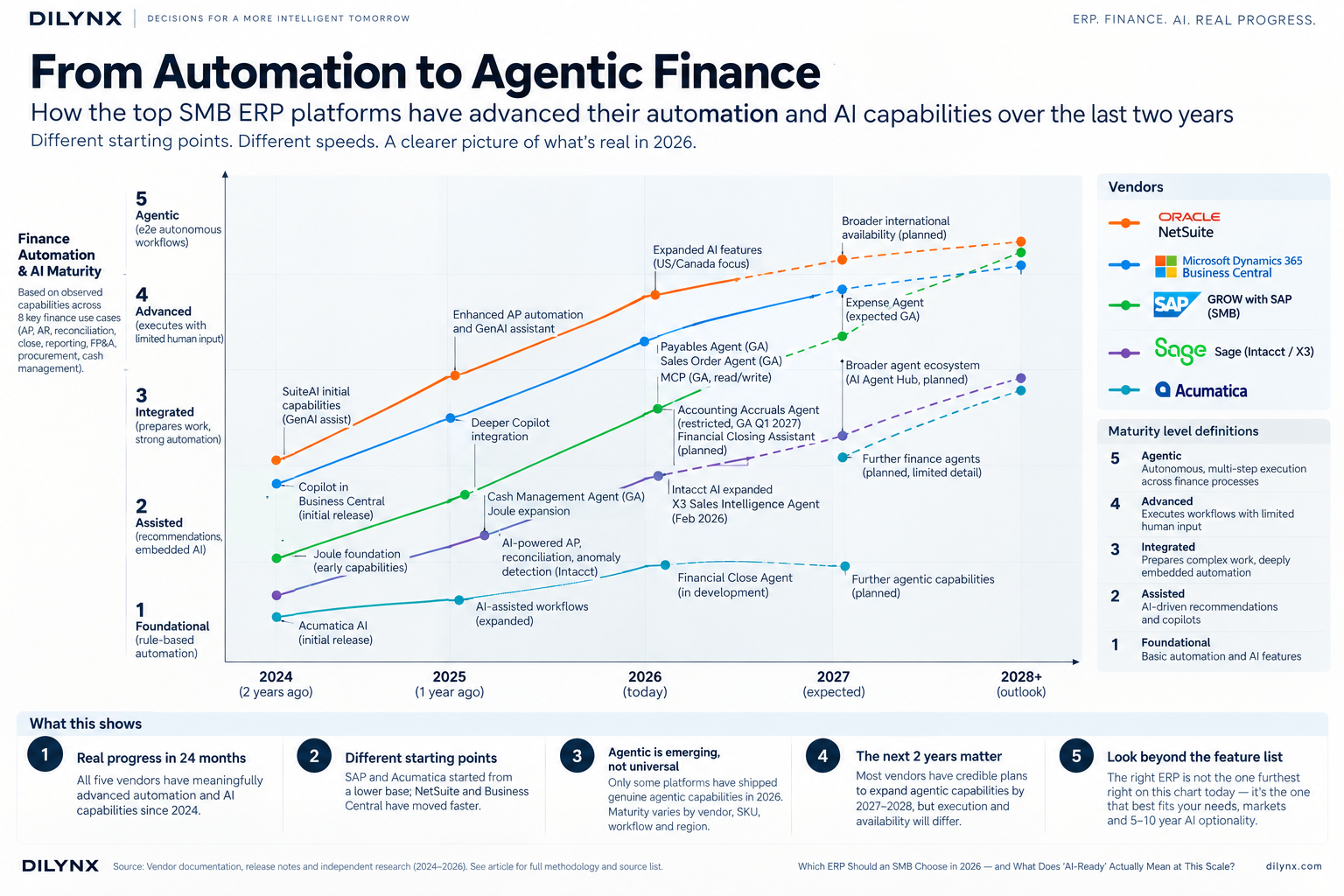
The first is the one most vendor conversations blur: AI that helps a person do finance work is not the same claim as AI that does finance work. We grade every capability on a five-level scale, adapted from our enterprise research — think of each level as a different instruction you could give the system. Level 1: write the explanation — drafts or summarises text, touches nothing else. Level 2: tell me what looks wrong — flags an anomaly or suggests a match, a person decides. Level 3: prepare the correction — assembles a transaction ready for approval, does not commit it. Level 4: execute the correction under predefined controls — acts, inside rules someone else set, with limited human involvement. Level 5: figure out what needs to happen, do it, and escalate only the exceptions — interprets a task, gathers information across systems, decides the next step, acts, and asks for a person only where the control model requires it. A vendor's own use of the word "agent" is never taken at face value here — the level is assigned from what the documented capability actually does, and, as the SAP section below shows, a capability announced at one level can still be shipping, months later, at another.
The second distinction is architectural, and arguably more durable: can an external AI agent — one this vendor did not necessarily build — reach the platform's data and business logic under permissions and an audit trail the buyer controls, or only through the vendor's own interface? This recurs across our research at every scale, commonly built on an open connection standard called the Model Context Protocol, or MCP. The interesting question is not whether a product page lists "MCP" — every vendor here now does. It is what the connection actually permits: can it write back into the ledger or only read from it, is access scoped to what a human user could already see, and is every action logged the way a human-entered transaction would be. An ERP that answers those questions well benefits from every future improvement in the wider AI market, regardless of which vendor ships it; one that does not benefits only from its own roadmap — and an open connection layer only helps if the data behind it is trustworthy in the first place, a separate and, for most finance functions, harder problem than any platform choice can solve alone. Four of the five platforms here have shipped some version of this layer; their maturity differs sharply, argued in detail below.
The five platforms, compared
The five are not a ranking. Each represents a distinct trade-off, and the comparison below is factual description, not a score.
| Dimension | Oracle NetSuite | Business Central | SAP (Business One / GROW) | Sage (Intacct / X3) | Acumatica |
|---|---|---|---|---|---|
| Core finance | Broad — up to 250 subsidiaries, real-time consolidation | Solid — consolidation native but manual-elimination | Business One: solid, FP&A weak. GROW: broad | Intacct: deep pure-play. X3: broad, operations-embedded | Broad — mature Global Financials module |
| SMB fit | Moderate; friction below ~100 FTE | Broad — purpose-built for this segment | Split by SKU (see below) | Intacct: broad. X3: skews upper end | Broad — historically its core market |
| Automation | Broad — native OCR, PO-to-pay | Broad — two agents GA, a third in preview, FY26 | Business One: no native AP automation. GROW: broad | Broad — GA close automation, 3-way match | Moderate — Level 1–3 shipped |
| Embedded AI | Broad, region-gated | Broad, several features still preview | Business One: Level 1 only. GROW: broad | Broad but early-rollout in most countries | Moderate — "Managed Availability," read-only |
| Agentic capabilities | Narrow — EPM agents license-gated, early-adopter | Advanced — Payables & Sales Order Agents, GA and executing live | GROW: mixed — Cash Management Agent live; Accounting Accruals Agent restricted, GA targeted Q1 2027. Business One: none | Moderate — Marketplace infrastructure GA; native agentic finance mostly early-rollout | Limited — native agentic close explicitly "in development" |
| Analytics / FP&A | Limited — native reporting repeatedly described as structurally constrained | Moderate — traditional ML forecasting | Business One: limited. GROW: broad | Moderate — variance analysis, outlier detection GA | Limited — not a differentiator in this research |
| International / multi-entity | Broad, but e-invoicing coverage has named gaps | Broad within 15 first-party-localized European countries | Business One: moderate. GROW: broad | Broad — both products natively multi-entity | Moderate — European statutory depth unverified |
| Ecosystem | Broad (SuiteApps) | Broad (AppSource, Power Platform) | Broad (~850 partners for Business One) | Broad | Moderate — smaller than NetSuite/Dynamics |
| Recent innovation | Broad, dated, geography-uneven | Advanced — a genuine 2026 inflection point | GROW: advanced but roadmap outpaces shipped status. Business One: limited | Broad — three dated 2026 releases | Broad — dated 2025 R1/R2, 2026 R1 cadence |
| Key caveat | Subsidiary structure largely fixed post go-live; most AI-forward layer is US/Canada-only | Several everyday Copilot features are English-only even in localized UIs | The SKU split is the whole story — see below | X3's interface is a real, independently corroborated weakness; Intacct's is not | Second private-equity owner in six years (Vista, from EQT, 2025) |
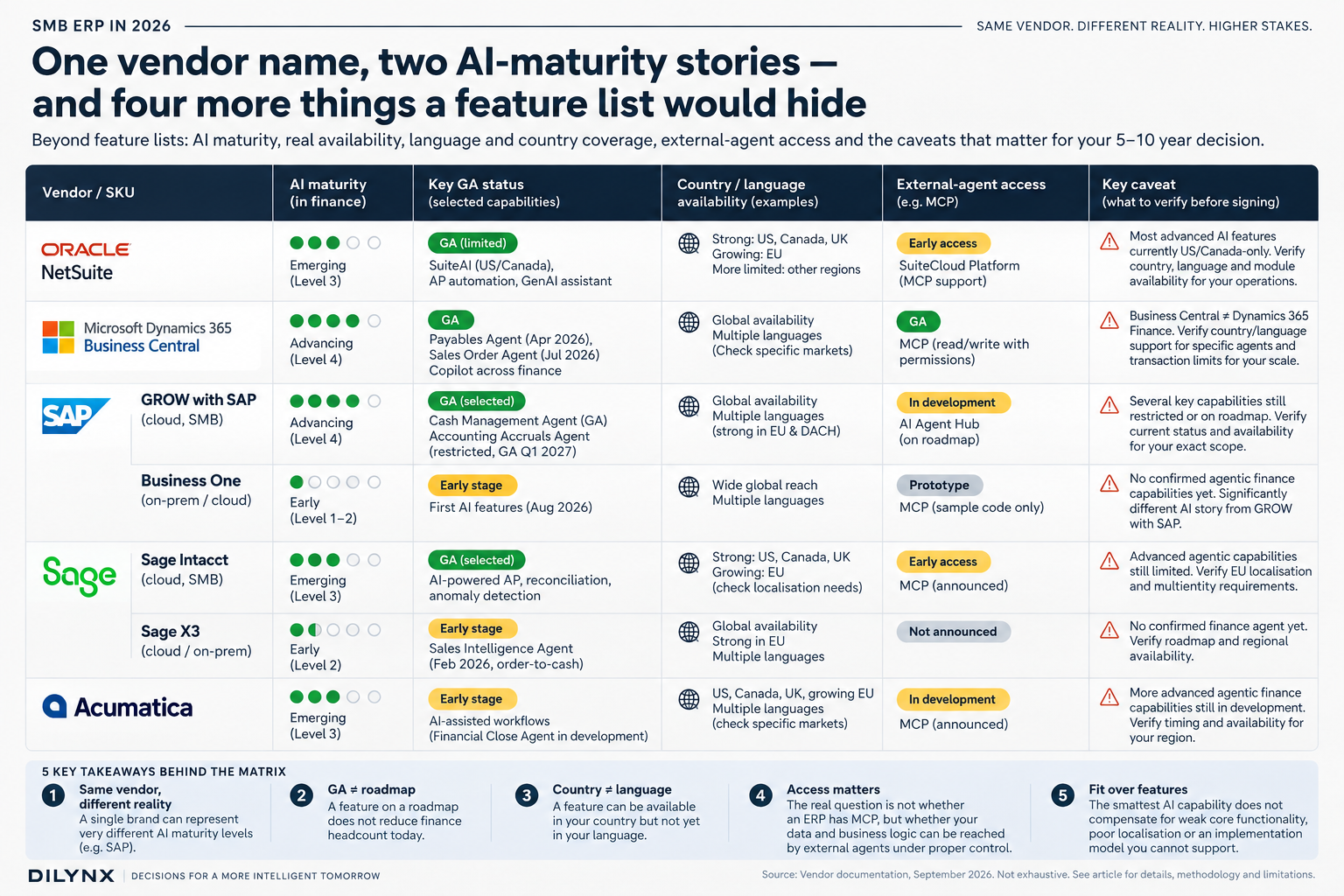
The table above still compresses a five-column, ten-row reality into single cells. The exhibit below expands the dimension it can't show well: how AI maturity, GA status, country and language availability, and external-agent access diverge within a single vendor's product line, not just between vendors.
Oracle NetSuite
NetSuite remains the platform most companies in this segment already know, and its core finance architecture — OneWorld, supporting 190-plus currencies and up to 250 subsidiaries with real-time consolidation — is genuinely mature. What is less discussed: subsidiary structure is largely fixed once a company goes live. Restructuring an entity — inserting a holding company above an existing one, say, as an international group reorganises for tax purposes — commonly means provisioning a new legal entity and manually migrating balances rather than re-parenting the existing one, and base currency cannot change after subsidiary creation. For a company expected to restructure as it grows internationally over a decade, that is a real, under-priced constraint.
NetSuite's AI layer is broad but unevenly available, along three separate lines that are easy to conflate. On country: the July 2026 NetSuite Next release introduced a conversational assistant, Ask Oracle, which Oracle's own release page states is "available to customers in the United States and Canada, with rollout to additional countries planned in future releases" — the platform's most AI-forward layer is, today, not available to a European buyer at all. On SKU: native EPM Reconciliation and Planning Agents exist but require a separately licensed EPM product, described by at least one source as early-adopter previews rather than broadly available — a company evaluating "NetSuite" without pricing the EPM add-on has not seen the platform's most agentic capability. More encouragingly, an October 2025 partnership with BILL brought genuine AI-driven payment automation to accounts payable, though its execution layer currently supports US banks only. What travels furthest, architecturally, is NetSuite's AI Connector Service: infrastructure, built on MCP, letting external tools such as Claude or ChatGPT query and act on NetSuite data under a defined security model — a layer that matters more for the next decade than any single feature, because it does not depend on Oracle shipping the next one.
Germany is a useful, concrete compliance test. German businesses have had to receive structured e-invoices since 1 January 2025; from 1 January 2027, businesses with prior-year turnover above roughly €800,000 — which covers almost every company in this segment — must issue them for domestic B2B transactions, extending to smaller businesses from 2028. NetSuite's native EU coverage handles outbound issuance for Belgium, Denmark, France, Poland and Spain, and inbound receipt for Belgium, Denmark, France, Germany and Spain — Germany's outbound requirement, the one binding on most of this segment from January 2027, sits outside native coverage and would need third-party middleware.
Good for: a company already comfortable with NetSuite's ecosystem, at the upper half of this segment, whose international footprint does not yet require the platform's most advanced AI layer to be available outside North America. Verify before signing: whether the EPM agents shown in a demo are included in the quoted licence or a separate line item, and whether your specific German entity's 2027 e-invoicing obligation is covered natively or needs a third-party gap-filler.
Microsoft Dynamics 365 Business Central
This section requires more precision than most, because the product most people associate with Microsoft's AI story in finance — an ERP-wide MCP server enabled by default, the agent features covered in our enterprise research — describes Dynamics 365 Finance, Microsoft's larger, upper-mid-market SKU. Business Central is a different product, sized for this segment, and it does not share that AI architecture. Business Central has its own, separately shipped Copilot and agent layer, built and released on its own schedule, and the two should never be conflated in a sales conversation or in this piece.
That said, Business Central's own 2026 release wave 1 is a genuine inflection point. Take a 220-person distributor processing roughly 2,000 supplier invoices a month. The Payables Agent, generally available since April 2026, monitors the AP mailbox, extracts each invoice, identifies or creates the vendor record, matches it to its purchase order, drafts the posting lines, and sends a human supervisor only what it cannot resolve — a price mismatch, an unrecognised vendor, a missing PO. Microsoft has built visible guardrails around it too: a task pane showing every action an agent has taken, and a literal stop all active tasks control an administrator can hit at any time. That is genuine Level 5 capability, with real ceilings worth checking against your own volume — up to 500 invoices and 100 emails a day per company. The Sales Order Agent, generally available since July 2026, does the equivalent on the revenue side: multi-turn email clarification with a customer, item matching, a calculated delivery date, a drafted quote — holding every outgoing customer email for review by default, though a company can configure that review away entirely, which is a decision a controls owner should make deliberately.
A third agent, for expense capture, is not yet at the same stage. Microsoft's own release-plan data, current as of early September 2026, shows the Expense Agent still in public preview across every sub-feature, with no general-availability date yet published — a related, more traditional expense-reports feature is targeted for October, a reasonable signal the agent is not far behind, but not the same claim as shipped.
Business Central's own MCP server reached general availability in April 2026, enhanced in June — but it is architecturally distinct from the Dynamics 365 Finance version covered in our enterprise research: read-only by default, requiring explicit per-area permission for write access, and billed through consumption-based Copilot Credits rather than bundled into a flat subscription. That is a more cautious default than the Finance SKU's — arguably the more defensible starting posture for a finance system of record.
The most consistent limitation for a European buyer is language, not geography. Several everyday Copilot features — Autofill, Chat, sales-line suggestions, e-document matching — are validated only in English, even in countries where Business Central's own interface is fully localized: a Polish or Italian finance team can be running a fully local edition of the software and still find its AI features unsupported in their working language. Multi-entity consolidation is native but relies on manual intercompany elimination rather than an automated engine, with third-party guidance suggesting a comfortable native ceiling around two to eight entities before an ISV add-on becomes necessary.
Good for: a company already inside, or willing to commit to, the Microsoft ecosystem, whose finance team can operate comfortably in English for its most advanced AI workflows even where the rest of the interface is localized. Verify before signing: whether your specific country sits inside Business Central's list of 15 first-party-localized European markets, and — separately — whether the finance team's actual working language is one the AI features themselves support.
SAP: Business One or GROW with SAP — not the same decision
SAP is often discussed as though it has one AI maturity level. It does not, and the gap between its two SMB-relevant products is wide enough that quoting one product's capability while selling the other would not be a rounding error — it would be a different sale. SAP Business One — sold through roughly 850 partners, on a codebase entirely separate from SAP's S/4HANA line — shipped its first generative-AI features (a contextual "Ask AI" assistant and natural-language query generation) in August 2026, has no equivalent to SAP Joule, and has no confirmed agentic finance capability at all. Its own MCP server exists only as sample code on SAP's developer help portal — thoughtfully designed, pausing for human approval before every write operation — but sample code is a starting point for a developer, not a feature a finance team can turn on.
GROW with SAP, a packaged edition of SAP S/4HANA Cloud Public Edition for mid-sized companies, tells a genuinely different story. At its May 2026 Sapphire conference, SAP stated GROW customers now receive more than 20 AI assistants from day one, against three in year one under the enterprise RISE with SAP programme. Two agentic finance capabilities were announced in the same February 2026 release, and their actual status, as of this research, diverges sharply. The Cash Management Agent appears genuinely in active use: it reads the day's bank statements, forecasts the day's cash position, flags accounts needing attention, and proposes transfers between surplus and short accounts — a materially different object from a dashboard that merely says cash is low, because it prepares the transfer rather than the observation. The Accounting Accruals Agent, announced alongside it with the same confidence, is a different case: independent reporting on SAP's own roadmap material places it under "restricted availability" through Joule — live for a limited set of customers, not broadly on — with full availability targeted for the first quarter of 2027, roughly a year after the capability was announced as part of the same release. A further, more ambitious Financial Closing Assistant, orchestrating multiple agents across the full close, was also announced at Sapphire; its target date has since shifted across the sources we reviewed and could not be confirmed as reached. Treat it as directionally real and not yet something to rely on.
Business One's core finance is solid for standard GL, AP, AR and banking, with a genuinely thin spot in FP&A — multi-dimensional budgeting becomes unmanageable natively per documented case experience, pushing most customers toward a third-party planning tool. It also lacks native invoice-to-payment automation, relying on partners such as Stampli, DOKKA and Tipalti to close the gap. No official SAP document states a hard revenue ceiling for either product, which means a company near the middle of this segment — roughly 250 FTE, €150m revenue — may genuinely find itself between a Business One it has outgrown and a GROW deployment sized above what it needs.
Good for: Business One suits a smaller, simpler, single-or-few-entity company that values SAP's partner-channel depth over AI maturity; GROW suits a company at the upper end of this segment that wants the closest thing to SAP's enterprise AI story without a full private-cloud implementation. Verify before signing: which product a proposal actually describes, and — for GROW specifically — ask SAP to state, in writing, whether each agent shown in a demo is generally available, restricted, or still roadmap. On the evidence gathered for this piece, that distinction would have changed the answer for at least one of SAP's two headline finance agents.
Sage: Intacct or X3 — again, not interchangeable
Sage Intacct and Sage X3 share a brand and a Copilot name, and little else in AI maturity terms. Intacct is a single, modern SaaS codebase — pure-play financial management, genuinely deep for services, SaaS, nonprofit and healthcare organisations, with a documented gap in native deferred-revenue rollforward reporting that finance teams rebuild manually at close. Its 2026 cadence has been dense: Close Automation and a Subledger Reconciliation Assistant reached GA, Intelligent 3-way matching reached GA across all regions, and an AI Agents Marketplace — infrastructure for third-party certified finance agents, distributed via AWS — reached GA in August 2026. Intacct's more ambitious agent, a natural-language Finance Intelligence Agent that retrieves insights, flags anomalies, and moves routine tasks such as payment reminders forward, was still described by Sage's own April 2026 announcement as scheduled for GA "later in 2026" — real and dated, but not yet something to assume is switched on.
X3 is a broader, operations-embedded ERP with real manufacturing and distribution depth, commonly positioned for 50 to 1,000 employees — sitting at or above this segment's upper end, and the right choice mainly when operational complexity, not finance alone, drives the decision. Its interface is a genuine, independently corroborated weakness across multiple 2026 buyer reviews — dated, complex, a documented steep learning curve — which Intacct, as a newer single codebase, does not share. X3's own AI news in this window is a Sales Intelligence Agent, announced alongside Intacct's Finance Intelligence Agent in February 2026, which flags overdue orders, delayed shipments and declining demand — an order-to-cash risk monitor, not a general-purpose finance agent; the deeper "Finance Intelligence" branding in Sage's 2026 announcements belongs to Intacct.
Both products carry active, dated European e-invoicing compliance work, including a mandatory France hotfix on X3 tied to the country's 1 September 2026 mandate — genuine evidence of investment, not a general claim.
Good for: Intacct suits a finance-led, services-oriented company inside this segment; X3 suits a manufacturer or distributor at or above its upper end, for whom operational depth matters more than interface polish. Verify before signing: whether the AI feature demonstrated is generally available in your country and language today, or on Sage's "later in 2026" track.
Acumatica
Acumatica's most distinctive feature has nothing to do with AI: its consumption-based pricing model, effectively unlimited users rather than per-seat licensing, genuinely suits an SMB with many occasional users — warehouse staff, field teams, seasonal workers — in a way per-user pricing does not. Nucleus Research has named it a leader in its SMB ERP Technology Value Matrix in both 2025 and 2026, and its architecture offers a real choice between multi-tenant SaaS and single-tenant or on-premise deployment that most competitors do not.
Its AI story is real but earlier-stage than the other four platforms in this piece, and — to its credit — the vendor's own documentation is candid about it. AI Studio, a no-code workflow builder, matured toward general availability through 2026; an AI Assistant reached only "Managed Availability" — a controlled, usage-capped, pre-GA programme — with the March 2026 release, and is explicitly read-only, unable to take actions or update records. Most tellingly, Acumatica's own product page lists AI-coordinated financial close workflows as "in development," not shipped — a harder claim than the single-step automations it already ships. Stating that plainly, on its own product page, is unusually candid.
The other material finding for a 5–10 year decision is ownership: Acumatica was acquired by Vista Equity Partners from EQT in a deal that closed in July 2025, its second private-equity sponsor in six years, and Vista has already begun consolidating vertical ISVs into the platform. That is not disqualifying, but it is a live governance question a board should ask about any vendor being committed to for a decade. Separately, no Tier 1 Acumatica documentation was found confirming the depth of German or French statutory and e-invoicing compliance — an open due-diligence item for a European buyer, not a demonstrated strength.
Good for: a company with a large, variable-headcount workforce for whom consumption pricing is a genuine cost advantage, and whose finance requirements do not yet demand agentic close automation. Verify before signing: Acumatica's own roadmap commitment under new ownership, and direct confirmation of European statutory compliance depth for your specific countries.
What actually changed in ERP AI over the last 12–18 months
Organising this by vendor would miss the point. The more useful lens is finance work: which processes moved from something a person does, to something software prepares, to something software actually executes.
Accounts payable moved furthest of any process researched. Business Central's Payables Agent (above) is the clearest shipped example — Level 5, a supervisor handling only exceptions. NetSuite and Acumatica both ship AI-driven invoice capture reaching Level 3, extracting and drafting for approval without the autonomous mailbox layer. SAP Business One has no native AP automation at all and depends on third-party add-ons — a reminder that "SAP" is not a single answer.
Bank reconciliation is the most broadly mature category researched. Business Central, Sage Intacct and Acumatica all ship AI-assisted matching at roughly Level 3 — the system proposes a match, a person confirms it — which makes it the best evidence for judging a vendor's AI claims against the residual manual percentage rather than the mere existence of the feature: a system closing 90% of matches automatically and one closing 40% can both truthfully advertise "AI-powered reconciliation."
The month-end close shows the widest gap between shipped visibility and shipped execution. Sage Intacct's Close Automation and NetSuite's Intelligent Close Manager both give real-time, AI-prioritised visibility into close status — genuinely shipped, but Level 2 to 3, telling a controller what looks wrong rather than fixing it. SAP's split cash-versus-accruals status (above) is the sharpest reason a CFO can't take a vendor's close-automation slide at face value. See our close acceleration playbook for what close acceleration requires beyond any single vendor's tooling. Cash positioning produced the research's only quantified vendor claim: SAP's agent reportedly cuts manual positioning time by up to 80%, a figure attributable to SAP rather than independently verified, but a useful illustration of the gap between a dashboard that says cash is low and an agent that proposes the transfer that fixes it.
Sales-order-to-cash and expense capture show the same pattern from opposite directions: Business Central's Sales Order Agent (above) ships with a cautious default a company can override; its sibling Expense Agent remains preview-only with no GA date published.
E-invoicing is where AI maturity and platform readiness most visibly diverge. Germany's 2027 issuance deadline (above) is a live test: NetSuite's native coverage doesn't yet reach it; Business Central's does, since May 2026. Odoo — the closest excluded contender — has the best-evidenced European e-invoicing story of any platform researched despite its weaker consolidation depth, exactly the asymmetry this piece keeps finding: AI-forward and structurally thin can be the same platform.
Underneath all of it, the connection layer argued above diverges just as sharply. Business Central, NetSuite, Sage and Acumatica have each shipped some version of it; SAP Business One's equivalent remains sample code only.
Laid end to end, these findings trace a single trajectory — five vendors moving from rule-based automation toward AI-assisted, then integrated, then in narrow cases genuinely agentic finance work, from different starting points and at different speeds. The exhibit below plots it. Read the solid portion of each line as graded evidence through 2026; read the dashed portion as vendor roadmap, not shipped capability.
Agentic ERP: what is real, and what is marketing
Every vendor in this research uses the word "agent." Not every vendor means the same thing by it. Rules execute a predefined process; an agent interprets a task and decides which step comes next. The distinction that matters for a buyer is not whether a vendor uses the word — it is where a specific capability actually sits on the five-level scale this piece has used throughout, confirmed by the vendor's own dated documentation rather than its marketing, the same discipline we set out in more depth in what changes when software acts. If a demo shows a polished chatbot answering questions about the ledger but the system cannot write anything back into it, the CFO in the room has not seen an autonomous workflow — they have seen a better search box. The practical test we would put to any vendor in a sales process, and recommend a CFO put to theirs, is simple:
Show me what the system can actually execute — live, on our own data — not what it can describe.
The strongest case against this piece's emphasis on agentic capability is that most companies in this segment do not yet need it, and buying for AI maturity they will not use for several years is itself a mistake. Agentic capability should carry real weight when a finance function already has standardised processes and a high-volume, repetitive workload — invoice processing at 2,000 a month, not 200 — where the ceiling on manual effort is the actual constraint. It should carry much less weight when the process itself is still inconsistent, because an agent trained on a messy process automates the mess. Odoo's exclusion illustrates the trade-off directly: its compliance story (above) and lower total cost of ownership make it a legitimate choice for a CFO who values that over agentic sophistication, over any of the five profiled here. We hold this at medium confidence against our own emphasis on agentic capability, because the evidence in this piece also shows the gap between AI-mature and AI-thin platforms widening release over release — a company that reasonably under-buys today may find that gap larger, and more expensive to close later, than the premium it saved now.
One boundary is worth stating before the test below. This comparison can narrow a strategic shortlist to the platforms and SKUs worth serious attention — it cannot replace vendor-specific diligence on implementation timeline and migration effort, total cost of ownership and ongoing operating cost, integration with adjacent systems such as banking, payroll, CRM, procurement or EDI, or comparable customer references at your own size and complexity. Those vary as much by implementation partner as by platform, and none of them is answered above. What follows is the test for narrowing the field; the diligence that follows it still has to be done.
The dilynx SMB ERP Fit Test
Seven questions that a feature-comparison table will not answer, because they are not about capability — they are about which capability you are actually being sold. These sit alongside, not in place of, the seven-question dilynx AI Optionality Test from our enterprise research, which remains the right tool for assessing an architecture's ability to absorb AI that does not exist yet.
- Which SKU, exactly? Put the exact product edition and every AI capability discussed into the
commercial proposal, in writing — not the vendor's brand name, and not what was shown in a demo of a different tier.
- Which countries, and which languages? Ask for an availability matrix covering every country
your finance team operates in and every language it actually works in — these are two different questions, and this research found platforms where the answer diverges sharply between them.
- Who owns the vendor, and since when? Two of the ten candidates researched changed
private-equity ownership within the last eighteen months.
- What can an external agent reach? Ask for a live demonstration of authentication,
permissions, write access and audit logging for the platform's MCP or equivalent connection layer — not a slide describing it.
- **What does the vendor's own documentation call "restricted," "early adopter" or "in
development"?** The most honest sentence on any vendor's product page is usually this one, and this research found it matters more than the headline announcement sitting next to it.
- What breaks above 100 users, or above eight entities? The ceiling a sales demonstration will
never show you.
- Can the vendor produce a comparable reference? A customer of similar size, entity count and
country footprint who has completed implementation — a conversation with their finance team about timeline, migration effort and total cost, not a logo slide.
Conclusion: what to actually optimize for
An ERP replacement at this scale is no longer only a decision about which system produces the cleanest trial balance. It is a decision about how much of the finance function's future execution — not just its reporting — a CFO is willing to hand to software, made at a moment when the honest answer to "which platform is AI-ready" is: parts of several of them, unevenly, and the parts change faster than the sales collateral does.
None of the five platforms in this piece has earned a verdict of unconditional AI readiness, and none should be bought on the strength of a single agentic feature demonstrated in a sales process. What separates a defensible choice from an expensive one is not which vendor has shipped the most features this year — that list will look different again in eighteen months — but whether the platform exposes its data and business logic openly enough to absorb whatever comes next, regardless of which vendor builds it. That is the real content behind the question this piece opened with: not simply which ERP has the best AI today, but which ERP gives your finance function the strongest combination of today's automation and tomorrow's ability to absorb AI nobody can yet predict.
Buy the SKU that matches your actual scale, confirm the country and language your business runs in, price the ownership risk alongside the licence cost, and ask every finalist to show you — not tell you — what its system can actually execute today. Once a platform is chosen, a smaller decision follows immediately — which bolt-on tools to match to that ecosystem rather than bought independently of it. The CFO who gets this decision right in 2026 will not be the one who bought the most AI-enabled ERP. It will be the one whose finance architecture can make the best use of whatever AI arrives next, because they tested for that capacity rather than assumed it.
Frequently asked questions
What is the best ERP for a company with 100–500 employees? There is no single best answer — it depends on whether the company is finance-led or operations-led and which SAP or Sage product line actually matches its scale. This piece profiles five platforms with the trade-offs for each rather than naming one winner.
Should an SMB replace its ERP now, or wait for AI-native ERP? The evidence does not support waiting — capability is shipping unevenly, process by process and SKU by SKU, not as one coherent release. If the current platform is the genuine constraint, waiting for a definitive AI-native successor is waiting for an event this research gives no reason to expect.
Is a cloud ERP with embedded AI worth paying more for than a simpler, cheaper platform? Not automatically. A platform with less native AI maturity can still be the right choice for a company whose processes are not yet standardised enough to benefit from automation. Buying AI capability the organisation is not ready to use is its own kind of expensive mistake.
Method and limitations
Ten ERP platforms were researched; five were selected for detailed evidence based on finance-led positioning (confirmed independently by Gartner Magic Quadrant placement in the finance-suite category rather than the operations/product-centric one), demonstrated shipped agentic or near-agentic capability, and relevance to a 50–500 FTE, internationally operating buyer. Grades reflect generally available capability, re-verified against current primary sources in September 2026 where material; announced, restricted, preview and roadmap functionality is identified as such throughout rather than credited as shipped — an earlier draft briefly over-credited SAP's Accounting Accruals Agent as shipped, corrected throughout to restricted availability, GA targeted Q1 2027. SAP's Financial Closing Assistant could not be confirmed as generally available at the time of this research. German e-invoicing timing is sourced to the Federal Ministry of Finance's own guidance rather than secondary summary. This is a dated assessment by construction, given quarterly and semi-annual vendor release cadences. Independent research. No paid placements.
Where to go next. For the enterprise-scale version of this question, including the seven-part Optionality Test this piece builds on, see Should CFOs Modernise... or Wait for AI-Native ERP? If the constraint you have identified is organisational readiness rather than the platform itself, start with the Finance AI Readiness Framework. And if the honest answer is that you are not yet sure whether your constraint is technology, process, data, control or capability, the Executive Finance Assessment will tell you which one is actually binding before you commit capital to fixing the wrong one.