

A financial controller can open a chat window this morning, paste in a trial balance movement and get a defensible first draft of the variance commentary before the coffee cools. That same controller will spend the afternoon chasing an intercompany difference through three spreadsheets and two colleagues, because the systems underneath do not connect the way the work does.
This is the position most finance functions are in. The AI experience around finance has moved faster than the systems that run finance. People are working with tools that reason well, then handing the output to platforms that still expect a human to reconcile, route, copy, validate, approve, investigate and carry information across a boundary the software never closed.
Out of that gap comes a specific and expensive question: modernise the finance technology landscape now, or wait until the ERP vendors have finished embedding AI?
The answer, in short
No — if the reason for waiting is the expectation that enterprise finance platforms will soon arrive at some definitive AI-native state. That expectation is not supported by the evidence, and a programme deferred on it is deferred on a date that will not come.
That is not the same as saying every CFO should modernise now. Waiting remains a rational decision on several grounds — a sound core, an organisation that is not yet ready, a replacement case that is weak on its own merits, an expected advantage that turns out to be roadmap rather than shipped capability. Those are reasons to wait. AI-native ERP is arriving is not one of them.
- **The market has largely automated the preparation of finance work and has barely begun to
automate its completion.** Across 42 graded platform-process combinations, 81% sit at assistance or embedded AI. Fourteen per cent reach execution.
- Agentic capability is real, narrow and concentrated. Six cells reach execution, each
one belonging to a single vendor — and two of the six are agent enablement infrastructure rather than finance work. There is no platform whose maturity is worth waiting for.
- Decide on constraint, not on capability. If the architecture is what limits value,
modernise. If the organisation is, build readiness. In many cases only part of the landscape binds, and selective modernisation is the most disciplined answer available.
Three answers select the option, and none of them is the vendor roadmap: where human intervention is most expensive, which of the five readiness dimensions is weakest, and whether the business case survives with AI removed from it.
AI is already changing finance — outside the ERP
General-purpose models have changed analytical and narrative work in finance faster than any enterprise software cycle in memory, and they did it without touching the ERP. Drafting commentary, interrogating a variance, summarising a contract, pressure-testing an assumption — this work moved because the tools sat next to the person rather than inside the system of record. The parts of finance that involve thinking about the numbers have been transformed. The parts that involve moving them largely have not.
Which is why the paradox is a poor guide to investment. Work that sits next to the person is cheap to change and cheap to reverse. Work that sits inside the ledger is neither. The speed difference between the two is a property of where the work lives, not a signal about which platform to buy.
The ERP is catching up — unevenly
The enterprise platforms have moved substantially in the last eighteen months. AI in enterprise finance software is no longer confined to a chat panel bolted onto a screen. Capability is being embedded into the transaction path itself, agents are being shipped into general availability rather than demonstrated at conferences, and parts of the landscape are becoming addressable by software the vendor did not write.
So the comfortable old answer — modernise now and the AI will arrive later — is no longer sufficient. It treats AI as a free upgrade that lands on whatever you happen to own. And the fashionable new answer, wait for AI-native ERP, is worse: it treats a diffuse, uneven, process-by-process progression as though it were a product launch with a date.
The market evidence explains why neither works.
Agentic finance is six cells wide
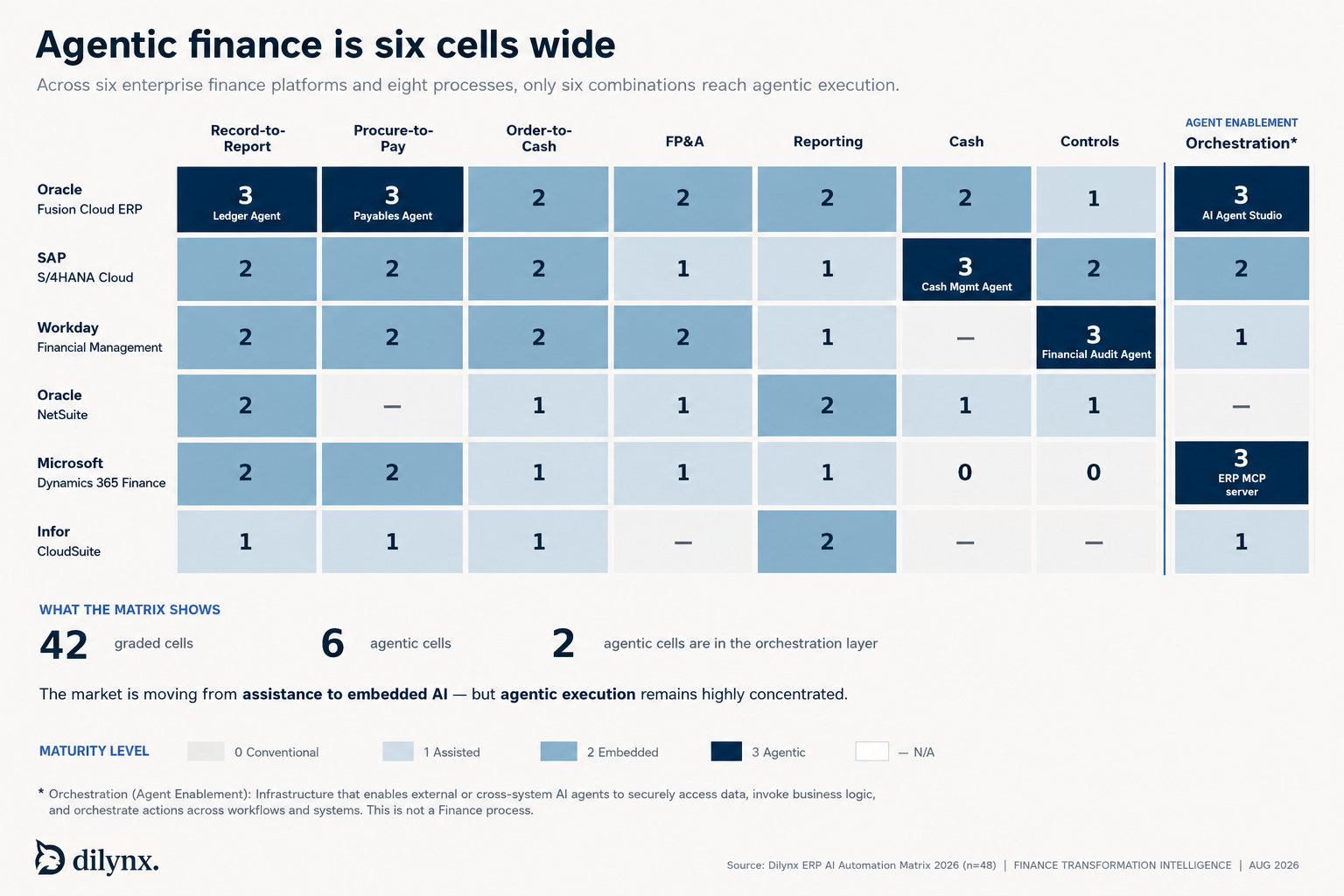
We reviewed six major enterprise finance platforms — Oracle Fusion Cloud ERP, SAP S/4HANA Cloud, Workday Financial Management, Oracle NetSuite, Microsoft Dynamics 365 Finance and Infor CloudSuite — across eight finance processes, grading 48 platform-process combinations against a common four-level maturity scale.
Level 0 is conventional automation. Level 1 is assistance: the system helps a person do the work. Level 2 is embedded AI: the system materially automates or augments the process itself. Level 3 is execution: the system reasons across context and takes action inside defined controls.
Platforms were included on one rule — a ledger of record for enterprise or upper-mid-market finance, with enough process-specific 2026 documentation to grade without inference. Only generally available capability was graded; announced, preview and early-access functionality was excluded. Where the public evidence was too thin to place a cell honestly, it is marked N/A rather than filled with an assumption. Six of the 48 fall into that category.
What the market evidence actually tells us
The distribution is the finding. Thirty-eight per cent of graded cells sit at assistance, 43% at embedded AI, 14% at execution and 5% remain conventional. The mean is 1.67 on a four-point scale.
The market has largely automated the preparation of finance work and has barely begun to automate its completion. That is the honest one-sentence description of enterprise finance AI in August 2026, and it is a very different proposition from the one the category marketing describes.
Four patterns matter more than the headline number.
No finance process has reached execution across the market. Every level-3 finance capability in the matrix belongs to exactly one vendor. One platform reaches execution in record-to-report and procure-to-pay; a different one in cash; a third in controls. There is no process where a CFO can say the market has solved this, and therefore no platform whose arrival is worth waiting for. Convergence is not visible in the evidence.
Agent enablement is ahead of the finance work itself. Two of the six execution-grade cells are not finance processes at all — they sit in the orchestration layer, the infrastructure that lets external or cross-system agents reach data securely, invoke business logic and coordinate actions across workflows. Microsoft ships a Model Context Protocol server for its finance and operations apps, generally available and enabled by default, which exposes data operations, form actions and invocable business logic to any compatible agent platform, scoped by the agent's own security role. Oracle's AI Agent Studio provides a comparable agent-enablement layer, with MCP tooling, A2A agent cards and policy controls.
This is one of the most consequential developments of 2026 — parts of the ERP landscape have become addressable by agents the vendor did not build — and it is almost invisible in the vendor narrative, because it is plumbing rather than product.
Announced capability materially exceeds available capability, and the gap is widest where the volume is highest. One vendor announced more than two hundred agents and fifty assistants at its 2026 user conference; independent analysis places most of them across a mix of general availability, early-adopter and preview status, with the packaged suite targeting general availability later in the year. Another vendor's published release plan for its flagship finance product lists exactly one agent feature for the entire six-month wave — and that one is an enhancement to an existing agent, dated for general availability in September. The rest of the section headed automation, AI and enhancements to core financials is settlement timing, bank clearance performance and financial tags.
Read the release plan, not the keynote. The distinction between generally available, preview, early access and roadmap is not a technicality — for a CFO signing a business case, it is most of the assessment.
Control maturity is lagging execution maturity. Controls is one of the two weakest columns in the matrix. At least one major vendor is scheduling its execution-capable finance assistants for general availability two quarters ahead of the governance capability designed to supervise them. That sequencing is where a modernisation programme quietly acquires an audit finding: the ability to act arrives before the framework that evidences the action.
AI does not automatically produce a better control environment. It produces a faster one, which is not the same thing, and which is only an improvement if the evidence, oversight and auditability arrive with it. We have set out elsewhere what changes at the moment software stops suggesting and starts acting; the market's current sequencing makes that question urgent rather than theoretical.
Two observations follow for any vendor conversation. Strengths are process-specific and do not aggregate into a ranking: the answerable question is not which platform is best at AI, but which is strongest in the two or three processes where your intervention cost is concentrated. And availability is not adoption — one vendor's recent financials release carried 137 changes, of which 109 require active customer intervention and 28 are auto-enabled. Capability now arrives switched off by design, because switching it on is a controls decision rather than an IT one.
Why "wait for AI-native ERP" fails as a reason
Waiting for AI-native ERP is not wrong because the platforms are ready. It is wrong because it rests on a model of how this technology arrives that the evidence does not support.
There is no single moment. AI maturity in enterprise finance is progressing process by process, vendor by vendor, quarter by quarter. Record-to-report and procure-to-pay are materially ahead of planning, reporting and controls, and the matrix shows real gaps in all three of those. The claim that the technology is simply not ready is becoming increasingly difficult to defend as a blanket statement — but it remains defensible for specific processes, and that is precisely the point. Waiting for the platform to become AI-native means waiting for an event that the evidence gives no reason to expect.
The constraint is usually somewhere else. KPMG's March 2026 survey of 1,013 senior finance leaders found active AI use in finance had risen from 30% to 75% since 2024, while fewer than half described themselves as fully assurance-ready for AI-enabled finance processes, and 36% named data quality as simultaneously their largest barrier and their largest opportunity. Replacing the ERP does not standardise a process, repair master data, redesign a control or teach a team to challenge a model's output.
Architecture is overtaking feature count. A platform's embedded AI feature list is a snapshot of one vendor's engineering priorities in one release cycle, and it depreciates on a quarterly cadence. An architecture that is accessible, interoperable, governed, standardised and capable of exposing business logic to agents does not depreciate that way. It compounds.
From AI features to AI optionality
The question a CFO should be asking about any current or proposed finance architecture is not how much AI it contains. It is this:
If AI capability improves dramatically over the next three years, how easily can this architecture absorb it?
We call this AI optionality, and it reframes the purchase from a bet on a vendor's roadmap into an assessment of how cheaply you can change your mind. Seven questions test it:
- Can AI tools reach the relevant finance data securely, under existing role-based
permissions rather than a parallel access path?
- Can business logic be invoked by an agent, or only clicked by a human?
- Can workflows be orchestrated across systems, or does each integration have to be built
and maintained individually?
- Are the processes standardised enough that there is a stable thing for a model to learn?
- Is the data semantically coherent enough that an output can be traced back to a source?
- Can the organisation change model or provider without rebuilding the landscape?
- Are the controls capable of governing machine-driven execution, not just human execution?
Question six is the one that 2026 made answerable, and question two is the one that has quietly changed value. An ERP that exposes its business logic to any competent agent under your own security model is worth more, over a decade, than an ERP with a longer list of native AI features and a closed perimeter — because the first benefits from every improvement in the wider market, and the second only from its vendor's.
The most future-proof architecture is not the one with the most AI today. It is the one with the greatest capacity to absorb the AI that arrives tomorrow.
Your ERP is only one part of finance AI readiness
An architecture can pass all seven optionality questions and still deliver very little, because the platform sets the ceiling and the organisation sets the floor.
Our Finance AI Readiness Framework scores five dimensions — data, process, control, capability and demand — on a common maturity spine, governed by a rule that decides most outcomes: readiness is constrained by the weakest dimension, not the average. An organisation scoring 4 on four dimensions and 1 on control is not mostly ready. It is not ready, and the average has concealed that.
Technology is deliberately absent from those five, and remains a separate question answered by the optionality test rather than a sixth dimension. This research is the strongest evidence we have that the separation was correct. The dimension most often responsible for the outcome is data, and the dimension that arrives late and expensively is control — precisely the column where the platforms themselves are weakest. Neither is fixed by a migration. Standardisation is not either: familiarity with a process is routinely mistaken for standardisation, and models cannot learn from a process that changes shape by preparer.
Buying ceiling when the floor is the binding constraint is the most expensive error available in this decision.
AI changes the ERP business case — it does not replace it
Finance technology business cases have historically rested on five things: cost, control, standardisation, scalability and risk. Those still hold. AI adds a sixth that behaves differently from all of them — the economics of human intervention.
The distinction matters. The first five value the architecture for what it is; the sixth values it for how much human work it leaves behind. Two systems with identical licence cost, control posture and scalability can differ by millions in the manual effort permanently embedded in the processes running on them — a difference traditional business cases never surfaced, because no technology moved it directly. AI does.
So the question to put alongside the other five:
How much human intervention will this finance architecture require in three years?
Intervention cost is what a familiar, comfortable, heavily customised landscape quietly inflates. Every exception routed to a person, every reconciliation performed by hand, every report assembled rather than produced, every hand-off that exists because two systems never agreed. A platform that is cheap to run and expensive to intervene in is a platform whose real cost is distributed invisibly across the establishment — which is why it survives budget scrutiny for years.
The symmetry matters, and vendors omit it. An AI-heavy platform does not reduce intervention if the process, data and control foundation cannot support it. Intervention economics cut in both directions, which is exactly why they belong in the business case rather than in the pitch.
Which produces the discipline test that should be applied before any other:
Would this transformation still have a credible business case if AI were removed from it entirely?
If the answer is no, AI is not the reason to do the programme. It is the reason someone wants it approved. A case that only works with AI in the numerator will be re-justified every time the market moves, and the market will move.
Three choices for the CFO
The decision is not replace-or-do-nothing. It sits inside a wider frame we have set out before — build, buy, extend or wait — and in this context it resolves into three options.
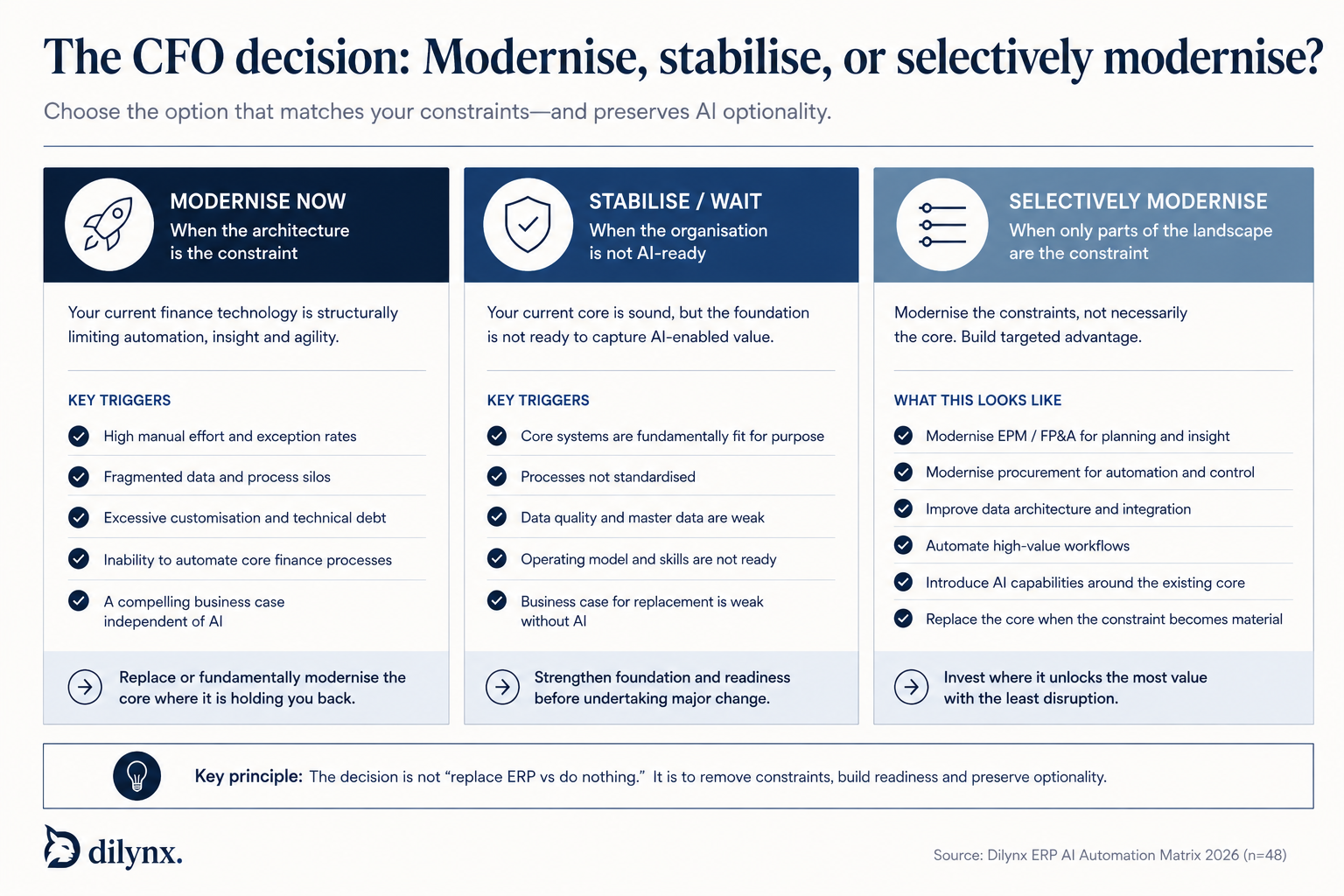
Modernise now when the architecture itself is the constraint: high manual effort and exception rates, fragmented data and process silos, customisation and technical debt that turn upgrades into projects, core processes that cannot be automated effectively — and a business case that stands without mentioning AI.
Stabilise when the organisation is the constraint: a core that is fundamentally fit for purpose, processes that are not standardised, weak data and master data, an operating model and skill base that are not ready. Stabilising is a decision with obligations attached, not a deferral. The readiness work is the programme.
Selectively modernise when only parts of the landscape are binding — often the most defensible option, and the one nobody is incentivised to sell.
Modernise the EPM and planning layer while the ledger stays where it is. Replace procurement without touching the core. Fund the data architecture as its own initiative with its own business case. Automate the two workflows carrying the highest intervention cost. Introduce agent capability around a stable core rather than inside a new one. Then replace the core when the architectural constraint becomes material — and be able to state in advance what would make it material.
Selective modernisation is not a compromise between action and inaction. It is frequently the most disciplined position available, because it invests where the constraint actually is, preserves optionality while the market is still moving, and keeps the largest and least reversible decision available rather than spent.
Two arguments cut against the position above, and both deserve stating properly.
AI-native challengers are outside the matrix, not outside the decision. Platforms such as Rillet and Campfire are excluded from the grading because the public, process-level evidence needed to place them on the same scale does not yet exist — not because they are irrelevant. Both have raised at scale and sell explicitly against incumbent mid-market suites. For a simpler finance architecture, and particularly for software companies and straightforward multi-entity structures, an AI-native challenger is a legitimate option, and for some of them it may deliver in eighteen months what selective modernisation of an incumbent suite delivers in four years. The absence of a grade is not a verdict.
Level 2 may be a plateau rather than a waypoint. We read the concentration at embedded AI as the market being early. It may instead be the level at which finance is willing to operate. If controls, auditability and professional accountability hold most finance work at the system prepares, a person completes, the execution frontier stays narrow for years and a CFO who modernised on the expectation of autonomy will have overpaid for a step that never arrived. We hold this at medium confidence against, because two vendors have shipped execution-grade capability into audited processes rather than around them. What would change our mind: if future release cycles add no new level-3 finance cells outside the vendors that already hold them, the plateau reading becomes the stronger one.
The CFO test
Ten questions worth taking into an investment committee. They are ordered deliberately; the last one decides more cases than the first nine.
- Where is human intervention currently most expensive, quantified rather than asserted?
- Which of those processes can the current architecture already automate, but does not?
- Which of the capabilities in the proposal are generally available today?
- Which are preview, early access or roadmap — and what happens to the case without them?
- Is the real constraint technology, process, data, control or capability?
- Does the proposed architecture increase AI optionality, or reduce it?
- What happens if the selected vendor's AI roadmap slips by two years?
- What happens if the best available model arrives from outside the ERP entirely?
- What can be modernised independently of the core?
- Does the transformation have a credible business case with AI removed?
Don't wait for AI. Build for it.
The evidence does not say the platforms are ready. It says they have moved far enough that the technology is not there yet is increasingly hard to defend as a general claim, and unevenly enough that wait for the winner was never a plan.
What changed in 2026 is smaller than the announcements and more consequential than the feature lists. Parts of the enterprise finance landscape became increasingly addressable by agents their vendors did not build — within existing security models and, where supported, existing control and approval boundaries. That shift makes any one vendor's AI roadmap less decisive, and your own architecture and organisational readiness more decisive, than at any point in the last decade.
Which means the finance architecture that wins the next ten years will not be identified by which ERP a company selected. It will be defined by how much work the system can perform without a person in the middle, how easily software can act on it under control, how far the underlying data can be trusted, how standardised the processes are, and how capably the organisation governs execution it did not personally perform.
So: modernise where the architecture is constraining value. Build readiness where the organisation is the constraint. Wait where waiting is genuinely the stronger decision — and be able to say which of those three you are doing, and why.
The advantage will not belong to the CFO who bought the most AI-enabled ERP. It will belong to the CFO whose finance architecture can make the best use of whatever AI comes next.
Method and limitations
Six platforms, eight processes, 48 combinations, 42 graded, six marked N/A. Grades reflect generally available capability documented in vendor release notes and product documentation as at August 2026, supported by independent release analysis; announced, preview and early-access functionality was excluded. Documentation quality is asymmetric — two vendors publish dated, structured release plans while others publish product pages, and grades resting on vendor language alone are held at medium confidence, including the level-3 controls grade. The two level-0 grades record the absence of AI capability in a published six-month release window, not proof of absolute absence. Release cadence is quarterly, so this is a dated assessment by construction. The cell-level evidence base, with source and confidence for every grade, is published alongside this article. Independent research. No paid placements.
Where to go next. If the constraint you identified is the organisation rather than the platform, start with the Finance AI Readiness Framework. If you want the wider market picture behind the grades, see what AI actually does in the Office of the CFO. And if the honest answer to question five is we are not sure, the Executive Finance Assessment will tell you which of the five dimensions is actually binding in your function before you commit capital to fixing the wrong one.