

What is changing in the Office of the CFO — and what to do about it
Finance transformation is not a software problem. It is a sequence of decisions — what to change, in what order, under which constraints — and most of them are made once, expensively, with no way to check the reasoning afterwards. This is the research library for those decisions: the recurring choices finance leaders face, the journeys that resolve them, and the maturity models that tell you where you actually stand.
The expensive mistakes happen before anyone opens a vendor website
Automating a process nobody has documented. Bolting a platform onto an ERP that already did the job. Starting an AI programme on data no one trusts. Buying in the middle of a hiring freeze. None of these are software-selection errors — they are sequencing errors, and no comparison table catches them.
Finance organizations commit hundreds of thousands — often millions — to software, consulting and transformation. Those decisions keep getting harder: hundreds of overlapping vendors, an AI wave reshaping every category, implementation ecosystems with their own commercial interests, and analyst research locked behind five-figure subscriptions. We built dilynx because we made these decisions ourselves, as finance leaders. Our objective is not to sell software — it is to help finance leaders decide well, through independent, evidence-backed research.
Each transformation decision is modelled as an archetype: the conditions that trigger it, the constraints that block it, and how it resolves.
Journeys are ordered and prerequisite-aware — every stage names the maturity it must reach before the next begins.
Independent — no paid placements. Rankings are never influenced by commercial relationships.
Browse by finance domain
The nine domains of the Office of the CFO — the permanent axis of this library. Every article, decision, journey and maturity model is published into one of them.
Featured research
Our research formats →Should CFOs Modernise Their Finance Technology Landscape Now — Or Wait for AI-Native ERP?
Finance teams are drafting commentary and analysing variances with AI while the systems underneath still route the work through people. That gap is widely read as a reason to wait for AI-native ERP. We graded six major enterprise finance platforms across eight finance processes on generally available capability. Six of 42 graded…
Read the Perspective →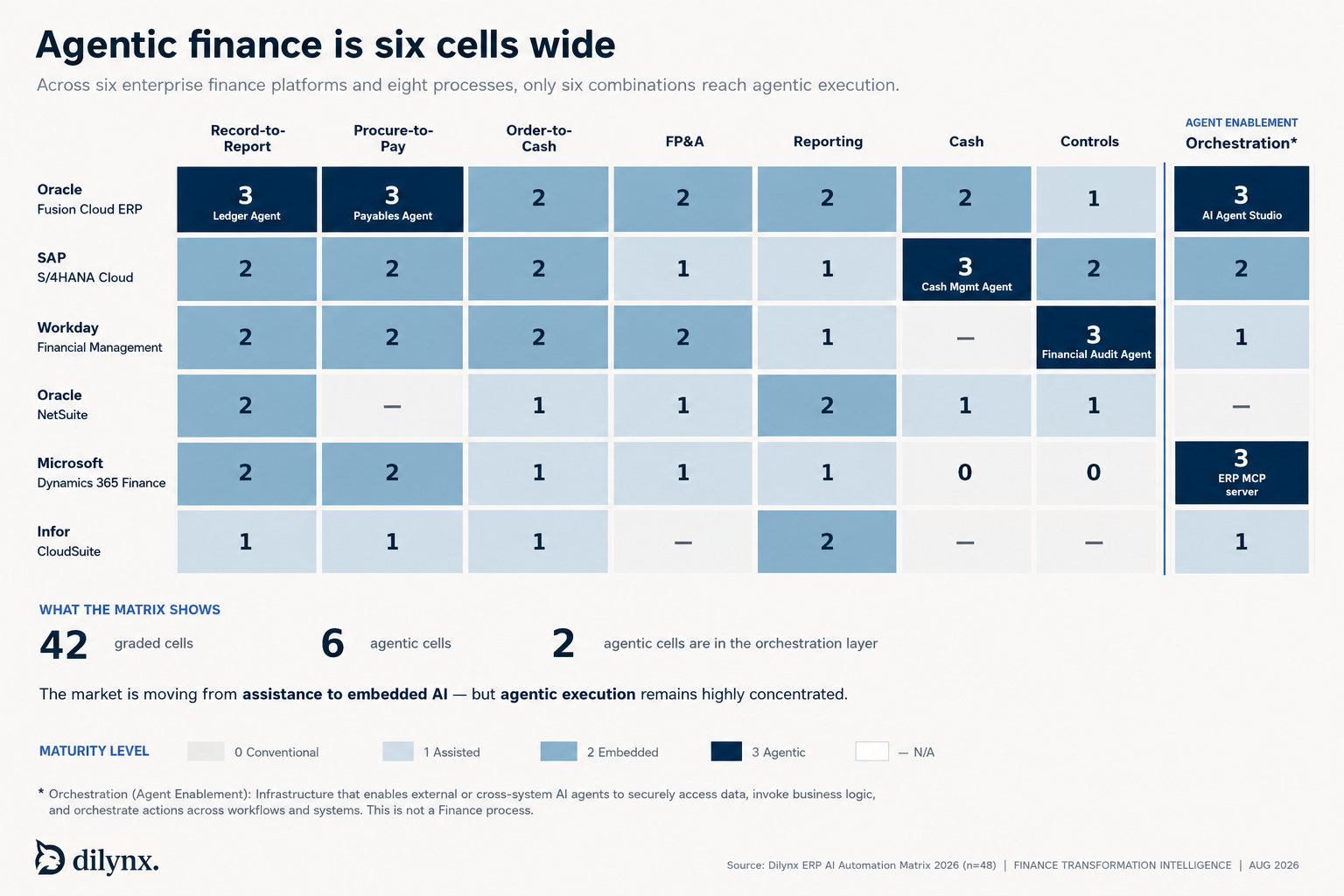
Flagship research
Our research formats →15 publications across 5 finance domains. Every one connects to the capabilities, benchmarks and decisions the rest of the platform reasons over — no isolated content. The AI publications are also gathered, across every AI research theme, on the AI in the Office of the CFO topic hub.
Standardize Before You Automate — and How to Tell If You Have
Almost every finance leader agrees that a process should be standardized before it is automated. Almost every finance function automates first anyway. The reason is not ignorance — it is that "standardized" is …
Build, Buy, Extend or Wait — The Decision Underneath Every Finance Technology Choice
Most finance technology decisions are framed as a choice between products. That framing has already skipped the actual decision, which is whether to buy a product at all. Four options are always available — bui…
The Finance AI Readiness Framework
"Are we ready for AI?" is being asked of finance leaders by boards, and answered badly in both directions — with enthusiasm that has no basis, or caution that has no argument. Readiness is not one thing. It is …
Close Acceleration — The Complete Playbook
Close acceleration fails more often from sequencing than from tooling. The work itself is well understood; the order is not. This playbook sets out five stages, each targeting a named capability at a specific m…
What "Good" Looks Like — Reading Finance Benchmarks Without Fooling Yourself
Benchmarks are the most misused instrument in finance management. The median gets adopted as a target, the spread gets ignored, and the peer set goes unexamined. This piece publishes the six distributions we ma…
The Cost of Finance Is the Wrong Target
Finance cost as a percentage of revenue is the most common justification for finance transformation and one of the least useful measures of it. It can be improved by doing less, it rewards deferral of investmen…
Why Finance Transformation Programmes Fail — Nine Failure Modes
Finance transformation programmes rarely fail for interesting reasons. They fail in nine recognisable ways, most of which are visible months before anyone admits them, and most of which are decided before imple…
Your Data Is Not Ready for AI — A Diagnostic
Finance AI programmes fail on data far more often than on models, and they fail late, after a successful pilot has created momentum and a budget. The reason the failure arrives late is that finance teams have b…
Agentic Finance — What Changes When Software Acts
The distinction that matters in finance AI is not how capable a model is. It is whether its output is a suggestion a human accepts or an action the system takes. Crossing that line changes the control model com…
What AI Actually Does in the Office of the CFO
We analysed the AI positioning of 71 finance software vendors, 50 of which carry curated AI capability analysis in our research base. Three findings stand out. AI claims cluster heavily in two domains rather th…
The Finance Transformation Sequence — Why Order Beats Selection
Most finance transformations are argued as a selection problem: which capability, which platform, which partner. The evidence from failed programmes says the binding constraint is almost never selection. It is …
The Finance Transformation Business Case — Sizing a Number You Can Defend
Finance transformation business cases fail in a specific and repeated way: they present one aggregate number, built mostly from headcount assumptions, at a confidence the evidence does not support. The number i…
Where the Cash Is Trapped — A Working Capital Diagnostic for the Office of the CFO
"Reduce DSO" is an instruction, not a diagnosis. Cash gets trapped in four structurally different places, and only one of them is fixed by collections effort. Two are not finance problems at all — they originat…
The Executive Guide to Finance Operating Model Design
The finance operating model is the largest and least reversible decision a CFO makes, and it is almost always argued at the wrong altitude. The debate is conducted about structure — centralise or federate, shar…
Transformation Decisions
All decisions →The recurring choices — each with the conditions that trigger it and how it resolves.
Standardize before automating
When the close is manual and the process undocumented, fix and standardize the process before buying tooling. Tooling on top of chaos automates the chaos.
Improve the ERP before buying a bolt-on
When the existing ERP's native close/reconciliation functionality adequately covers the need, deepen its use before adding a third-party platform.
Adopt dedicated software when scaling past spreadsheets
When the process is standardized (L2) and volume, entity complexity, or audit pressure exceeds what spreadsheets/ERP-native can carry, adopt a purpose-built platform.
Journeys & Roadmaps
All journeys →Browse by research type
The recurring decisions finance leaders face — and how they resolveJourneysJourneys & Roadmaps
Sequenced transformation arcs, with prerequisites in orderMaturityMaturity Models
Where a capability sits on the 1–5 spine, and what moves itResearchResearch Themes
The fifteen questions this pillar exists to answerResearchResearch Formats
The ten archetypes we publish in — and the standard each must meet
One connected journey — Understand, Assess, Implement
Three questions, in the order finance leaders actually ask them — understand the change, assess your own position, then find the partner who can deliver it. Each step answers one and hands you to the next.
Finance Transformation Intelligence
What is changing in the finance function, and what the best organisations do about it.
Explore →Finance Executive Assessment
What that means for your organisation specifically — your position, your highest-impact move.
Explore →Finance Transformation Marketplace
Who helps you actually deliver it — a curated network of finance transformation partners.
Explore →How this library grows
The architecture above is the destination, published in full today and populated continuously. Nine domains and five research types are permanent structure — new research is added into them, never alongside them. Where a category is still filling, it says so plainly rather than hiding: 2 of the nine domains are in early publication, and each states what it covers and what is in preparation. Nothing here is placeholder text pretending to be research.
Where does your finance organisation actually stand?
Reading about transformation is the first act. The Executive Finance Assessment is the second: your organisation's position, your highest-impact move, and the evidence behind it.
Begins with a free Executive Brief — about five minutes, anonymous, no account. Full assessment €59, one-time. It complements the research; it does not replace it.